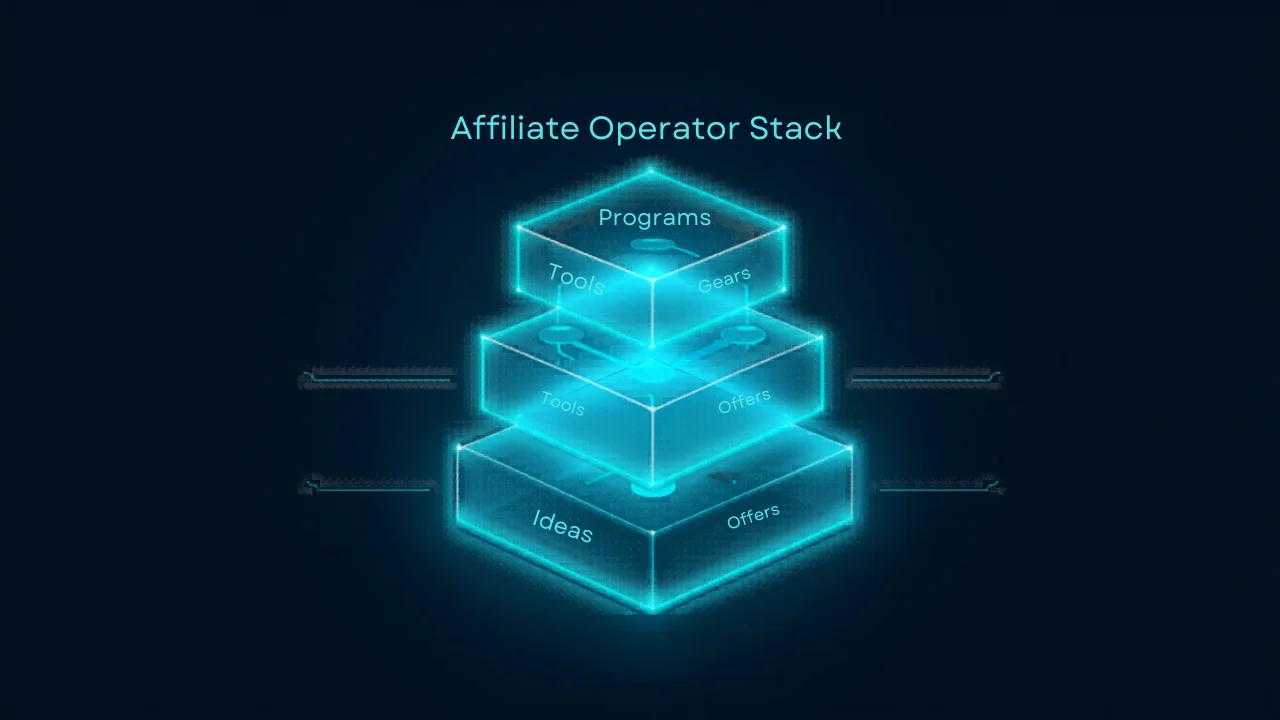
Most affiliate marketing advice treats programs, tools, and content as separate decisions. You pick a niche, find programs, write content, and hope the pieces connect. They usually don’t — at least not efficiently.
An operator stack approaches this differently. Every layer is chosen with the others in mind. The program determines what offers make sense. The offer determines what content is needed. The tools determine what content is sustainable to produce.
Quick Answer: A functional affiliate operator stack in 2026 has three layers — programs you actively promote, tools that power your production system, and offers that convert research intent into action. The layers reinforce each other. Optimizing one without the others produces diminishing returns.
What “stack” means in this context
Stack thinking comes from software engineering: a set of components that work together to produce an output, where each layer depends on and enables the others.
Applied to affiliate marketing:
- Programs layer — the affiliate programs you’ve committed to promoting. Not a list of everything you’ve signed up for. The 3–5 programs that align with your audience’s actual decisions.
- Tools layer — the software you use to produce content, manage the site, track performance, and run automations. Some of these tools have affiliate programs themselves.
- Offers layer — the specific pages, posts, and assets that translate a reader’s research intent into an affiliate click. Not the programs themselves — the content structures that bridge the gap.
A stack is functional when these three layers are mutually reinforcing. A stack is broken when you’re producing content that doesn’t connect to any offer, promoting programs that don’t match your audience’s intent, or using tools that can’t sustain your production volume.
The programs layer
Program selection in 2026 is less about commission rates and more about fit. The questions that matter:
- Does this program serve a decision your audience is actually making?
- Can you write 5–10 posts about this product category without running out of useful things to say?
- Is the program’s cookie window and attribution model compatible with your traffic patterns?
For AI tool-focused operators, the strongest program categories right now are: API platforms and routing tools, automation platforms (n8n, Make), AI writing and content tools, and knowledge management tools.
Programs with recurring commissions are structurally more valuable for building stable income than one-time high-ticket programs — assuming the product retains users. A 20% recurring commission on a $50/month SaaS is worth more than a $100 one-time payout if the user stays for more than 5 months.
The recurring vs high-ticket programs comparison covers this decision in detail.
The tools layer
Your production tools should serve double duty: they’re what you use, and many have affiliate programs worth promoting.
The tools worth building your stack around in 2026:
Content production: AI writing assistants (Claude, GPT-4o via API), specialized tools like Koala Writer for structured affiliate content.
Site and publishing: A static site generator (Astro, Next.js) or WordPress, with a deploy pipeline that removes manual steps. Hosting on Cloudflare Pages or Vercel keeps costs low.
Automation: n8n or Make for connecting tools without code. One well-built automation workflow for scheduling, publishing, and reporting saves hours per week.
Tracking and analytics: UTM tracking on every internal link, basic traffic analytics (Plausible or GA4), and a simple spreadsheet for commission tracking.
The stack doesn’t need to be large. It needs to be connected. A content site that publishes manually, tracks nothing, and has no automation is fragile — one missed week breaks momentum.
The offers layer
The offers layer is the most underbuilt part of most affiliate sites. Programs are signed up for. Content is written. But the specific pages that convert research intent into action — comparison pages, fit guides, decision frameworks — are missing.
The offers layer in a functional stack includes:
Comparison pages — head-to-head evaluations for the top 2–3 choices in a category. These capture high-intent search traffic where the reader is close to a decision.
Fit guides — “which option is right for me” content that routes the reader to the right program based on their situation. Higher conversion than generic reviews because they feel personalized.
Tool overview pages — persistent pages for each tool you actively promote, updated regularly. These build authority and serve as the landing point for internal links.
The find your best affiliate fit guide is an example of an offer-layer page — designed to route readers to the right program rather than to push a single option.
How the layers connect in practice
A reader arrives at a comparison post (offers layer) via organic search. They click through to your tool overview page (programs layer + offers layer). They follow an affiliate link with proper UTM tracking. You get commission attribution and traffic data.
That flow only works if:
- The comparison post targets a keyword with real search intent
- The tool overview page is current and credible
- The affiliate link is correctly formatted
- The UTM data feeds back into your tracking
Each broken link in that chain reduces the effective conversion rate of the entire stack. A high-traffic comparison post with broken affiliate links is worth nothing.
What a minimal functional stack looks like
For a solo operator starting out:
- 2–3 programs in a single niche
- 1 production tool (AI writing assistant) + 1 publishing platform
- 5 core offer pages: 2 comparison posts, 1 fit guide, 2 program overviews
- 1 automation: scheduled publishing
That’s enough to test whether the niche and program selection work before investing in scaling.
Frequently Asked Questions
How many programs should I actively promote? Start with 2–3. Depth of coverage beats breadth. A site with 20 posts about 3 programs will outperform a site with 20 programs mentioned once each.
Should my tools match my affiliate programs? Where possible, yes. Using and promoting the same tools creates authentic content and simplifies your stack. Don’t use a tool you don’t find valuable just because it has an affiliate program.
How do I know if my stack is working? Track three metrics: organic traffic to offer-layer pages, click-through rate on affiliate links, and commission revenue per visitor. If traffic is high but CTR is low, the offer pages aren’t converting. If CTR is high but commissions are low, attribution or cookie tracking may be broken.
What’s the most common mistake in stack design? Building the content layer without the offers layer. Writing informational posts that never route to a conversion point. Every post needs a clear next step that connects to a program.
How often should I audit the stack? Quarterly. Check: are all affiliate links still active? Are commission rates the same? Are the programs still relevant to your audience’s current decisions?
Map your operator stack
If you’re unsure which programs fit your current situation, the affiliate fit finder routes you to the right starting point based on your niche and audience type.