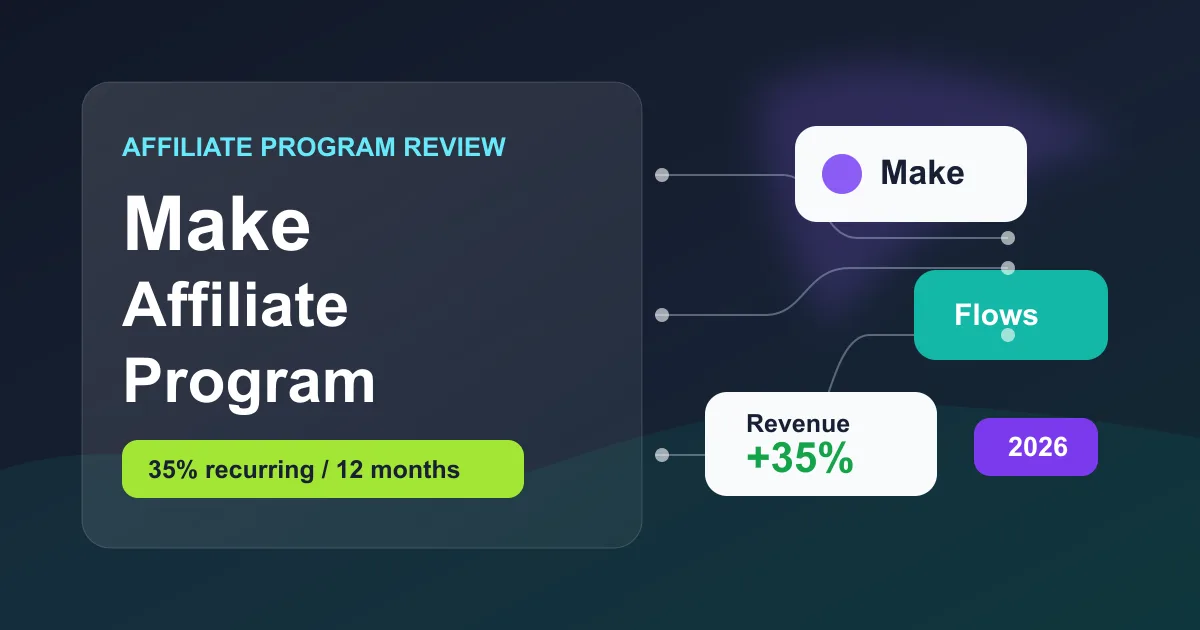
Make is one of the cleanest automation affiliate programs to build content around in 2026 because the product has a simple promise, broad audience fit, and recurring economics that are now stronger than many older reviews suggest.
If your content covers automation, no-code operations, AI workflows, creator systems, or small-business process design, Make belongs near the top of the shortlist. The important question is not whether Make is promotable. It is whether your audience is likely to become paying automation users instead of staying on the free plan.
Quick Answer: Make’s current affiliate program offers 35% commission on referral subscription payments for 12 months. The program is strong for creators who publish workflow tutorials, comparison content, and no-code automation guides. The main limitations are payout requirements, free-plan leakage, and the fact that commission is tied to subscription payments rather than extra operations.
What Is Make?
Make is a visual automation platform for connecting apps, APIs, databases, AI tools, and internal processes. Users build “scenarios” by connecting modules on a visual canvas, then run those scenarios on a schedule, webhook, or trigger.
The simple version: Make helps non-developers and operators automate multi-step work without writing a full application.
Common Make workflows include:
- Moving leads from a form into a CRM and Slack
- Turning newsletter ideas into drafts, tasks, and calendar entries
- Sending AI-generated summaries from email or documents into Notion
- Routing support tickets based on urgency, source, or customer type
- Connecting Claude, OpenAI, Google Sheets, Airtable, and publishing tools
Make sits in a useful middle ground. It is more flexible than basic trigger-action tools, but less technical than self-hosting n8n or building custom scripts. That makes it unusually promotable because the buyer does not need to identify as a developer before they see the value.
Make Affiliate Program: Current Commission Structure
Here is the current structure that matters for affiliate publishers:
| Detail | Value |
|---|---|
| Commission rate | 35% |
| Commission type | Recurring subscription commission |
| Duration | 12 months |
| Applies to | Subscription payments from referred paid users |
| Extra operations | Not commissionable |
| Payout method | Wise |
| Minimum payout | $100 plus 3 unique paying referred users |
| Retroactive attribution | Not supported |
The 35% rate is the headline. It is materially better than older Make affiliate references that described the program as 20% recurring or a mixed first-payment structure. For 2026 content, use the current 35% for 12 months structure unless Make changes the public terms again.
There is one nuance: the 12-month commission window starts when the referred user registers through your affiliate link, not necessarily from the date of first payment. If someone signs up today, waits a month, then upgrades, the commission period has already started. That makes conversion-focused content more valuable than broad top-of-funnel traffic.
Commission Math: What Referrals Can Be Worth
Make is attractive because automation users often upgrade once a workflow becomes part of their daily operations. A user who builds a lead-routing system, client onboarding process, or AI content pipeline is less likely to churn casually than someone testing a disposable AI writing app.
At 35% recurring for 12 months, the rough math looks like this:
| Monthly plan price | Monthly commission | 12-month total per referral |
|---|---|---|
| $10/month | $3.50 | $42 |
| $20/month | $7 | $84 |
| $35/month | $12.25 | $147 |
| $99/month | $34.65 | $415.80 |
The program becomes especially interesting when your audience includes agencies, operators, and small teams. A solo beginner may stay on a low plan. A team running client automations or production workflows can move into higher monthly spend quickly.
This is why Make works well inside an automation content cluster instead of as a single isolated review. A standalone review can rank eventually, but tutorials and comparisons create the repeated exposure that moves readers from curiosity to implementation.
The Payout Requirement Matters
Make’s payout rules are not hard, but they do affect new affiliates. To request a payout, you need both:
- At least $100 in commission
- At least 3 unique paying users referred through your link
That second condition matters. One strong referral is not enough if you have not referred three paying users. This makes Make better for publishers who can build repeatable traffic through SEO, YouTube tutorials, newsletters, or workflow templates.
For a new site, Make is not the fastest first-dollar affiliate program. For a site with automation content momentum, it can become a strong recurring layer.
Who Converts Best for Make?
Make converts best when the reader already has a messy workflow they want to clean up. The strongest audience types are:
- No-code operators who run multiple SaaS tools and need them to talk to each other
- Creators and newsletter operators building research, publishing, and repurposing systems
- Small agencies that need repeatable client onboarding, reporting, or lead-routing workflows
- AI workflow builders connecting LLMs to Sheets, Airtable, Notion, Slack, and publishing tools
- Zapier users who want more visual control or better economics at higher workflow volume
Make is less ideal for audiences who want one-click tools with minimal setup. If your readers are complete beginners who do not yet understand what automation can do for them, lead with use-case tutorials rather than affiliate-program language.
The best content does not say “buy Make.” It shows a workflow that saves time, then positions Make as the easiest way to build it.
Make vs n8n Affiliate Program
Make and n8n are the natural pair for automation affiliate content. Both are legitimate, both are promotable, and both fit MoltyFlywheel’s automation cluster. The difference is audience and conversion path.
| Make | n8n | |
|---|---|---|
| Commission | 35% recurring | 30% recurring |
| Duration | 12 months | 12 months |
| Best audience | No-code operators, agencies, creators | Technical operators, developers, AI workflow builders |
| Product model | Managed SaaS | Cloud plus self-hosted |
| Free/self-hosted leakage | Free plan users | Self-hosted users |
| Strongest content angle | Tutorials and comparisons | Cloud vs self-hosted, technical workflows |
Make has the stronger published commission rate right now. n8n has a deeper technical moat and a strong open-source audience, but self-hosted users do not convert into affiliate revenue unless they move to Cloud.
For MoltyFlywheel, the best strategy is not choosing one. Use Make for beginner-friendly automation tutorials and no-code workflow posts. Use n8n for technical AI operations, self-hosted comparisons, and advanced automation content. Then connect both through comparison posts like n8n vs Make for AI publishing.
Best Content Angles for Promoting Make
The Make affiliate program rewards practical content. Readers need to see the automation before they feel the pain clearly enough to pay.
Strong content formats:
-
Make vs Zapier comparisons
These capture readers who already know they need automation and are choosing a platform. The Make vs Zapier for AI operators angle is especially useful for AI-heavy workflows. -
Workflow tutorials
”How to automate lead capture with Make,” “How to summarize emails with Claude and Make,” or “How to build an AI publishing workflow with Make” are better conversion assets than generic reviews. -
Stack posts
Make works well inside operator-stack content: Claude plus Make plus Airtable, Obsidian plus Make, or newsletter research plus Make plus beehiiv. -
Cost comparisons
Readers who hit Zapier pricing limits are often ready to switch. Make content that explains operations, scenarios, and plan fit can convert well. -
Template-led content
Scenario templates reduce friction. A reader who can copy a workflow is closer to activation than a reader who only understands the abstract benefit.
For internal linking, route Make content into the Make program page, the affiliate operator stack, and the best affiliate programs by workflow type cluster.
Honest Limitations
- Free-plan users may not convert quickly. Make has a useful free plan, which is good for adoption but can delay affiliate revenue.
- Payout requires 3 paying users. This is reasonable for established publishers but slower for new affiliates.
- Commission does not apply to extra operations. If a customer buys extra operations, that is not part of the affiliate commission.
- The product needs education. Make is easier than custom code, but beginners still need help understanding scenarios, operations, routers, filters, and error handling.
- Attribution is not retroactive. If a reader signs up without your link, they cannot be added to your affiliate account later.
None of these are dealbreakers. They simply mean Make works best when promoted through helpful workflow content rather than broad “best tools” lists alone.
MoltyFlywheel Verdict
Make is a strong affiliate program for 2026. The current 35% recurring commission for 12 months is competitive, the product is sticky once users build real workflows, and the audience fit is broad enough to support tutorials, comparisons, and operator-stack content.
For MoltyFlywheel’s automation cluster, Make should be treated as the beginner-to-intermediate automation anchor. Pair it with n8n for technical readers, Zapier comparisons for switching intent, and AI workflow tutorials for high-conversion use cases.
If you are building affiliate content around automation tools, Make is worth promoting. The best move is to avoid a thin review-only strategy and build a small cluster: one program review, one Make vs Zapier post, one Make vs n8n post, and two or three concrete workflow tutorials.
That is where the recurring economics start to make sense.
FAQ
How much does the Make affiliate program pay?
Make currently pays 35% commission on subscription payments from referred users for 12 months. Commission applies to subscription payments, not extra operations.
Is the Make affiliate program recurring?
Yes. The program pays recurring commission for a 12-month period tied to referred users who register through your affiliate link and become paying subscribers.
What is the Make affiliate payout threshold?
Make requires at least $100 in commission and 3 unique paying referred users before you can request a payout. Payments are processed through Wise.
Is Make better than n8n for affiliates?
Make currently has the higher published commission rate, while n8n has a strong technical audience and Cloud upsell path. Make is usually easier to promote to no-code operators and creators. n8n is stronger for technical workflow builders.
What content works best for the Make affiliate program?
Workflow tutorials, Make vs Zapier comparisons, Make vs n8n comparisons, AI automation guides, and template-led posts tend to work best. Generic listicles can help discovery, but practical workflow content usually converts better.
Can someone be added to my Make affiliate account retroactively?
No. Users need to register through your affiliate link for attribution. Make does not support adding users to an affiliate account retroactively.